To provide handrails to a stairway or ramp, in corridors in Class 9a and 9c buildings and in corridors required to be accessible by people with a disability.
D3D22 addresses requirements regarding the location, spacing and extent of handrails. Where both barrier and handrail matters require consideration, D3D22 must be read in conjunction with those of D3D17 to D3D21.
Handrail location and separation—D3D22(1)(a) and (b)
D3D22(1)(a) and (b) set out the location and separation requirements for handrails. For intermediate handrails, see the requirements in D3D10.
Handrail heights: Primary schools—D3D22(1)(c)
D3D22(1)(c) requires a second handrail located at a practical height between 665 mm and 750 mm in a primary school, to aid children who are generally shorter than adults.
Handrail heights: 865 mm height requirement—D3D22(1)(d)
Under D3D22(1)(d), the height of handrails is a minimum of 865 mm, so that they are comfortable to use for most people and provide adequate stability support and assistance. Measurement for determining compliance with D3D22(1)(c) and (d) must be done in accordance with D3D22(2).
Continuous handrails
D3D22(1)(e) requires a continuous handrail between stair flight landings. It does not apply around a landing between flights, as such a requirement would often be impractical.
Obstructions placed on handrails to prevent people deliberately sliding down them must be considered on a case by case basis to determine whether a hand hold is broken. Ball type stanchions at the top of supports to handrails may be permissible. See Figure D3D22a.
Handrails in exits
D3D22(1)(f) requires handrails in a required exit serving an area required to be accessible, to comply with clause 12 of AS 1428.1, to facilitate use by people with a disability.
Handrails in Class 9a corridors—D3D22(3)(a)
The D3D22(3)(a) provisions requiring handrails on at least one side of corridors in a Class 9a building are intended to assist patients.
Handrails in Class 9c corridors—D3D22(3)(b)
The D3D22(3)(b) provisions requiring handrails in corridors in a Class 9c building are intended to assist residents. The handrails are required on both sides of the corridor to assist residents accessing the common areas such as dining rooms and recreation rooms in their day to day living.
People with a disability—D3D22(4)
D3D22(4) is provided to remind users of the NCC that there are specific requirements for handrails to provide access for people with a disability under Part D4.
Handrails for sole-occupancy units in Class 2 or 3 buildings or a Class 4 part—D3D22(5)
D3D22(5) requires handrails on at least one side of a stairway or ramp. The top rail of a barrier could be a handrail. The handrail must extend the full length of the flight or ramp except where the handrail is associated with the barrier, in which case the handrail can terminate where the barrier is allowed to terminate. This would allow for the barriers of geometric stairways such as elliptical, spiral, circular or curved stairways to finish a few treads from the bottom of the stairway. A handrail is not required for winders if a newel post is installed to provide a handhold.
Examples
A handrail is not required for a flight of only 5 risers as the change in elevation would be less than 1 m.
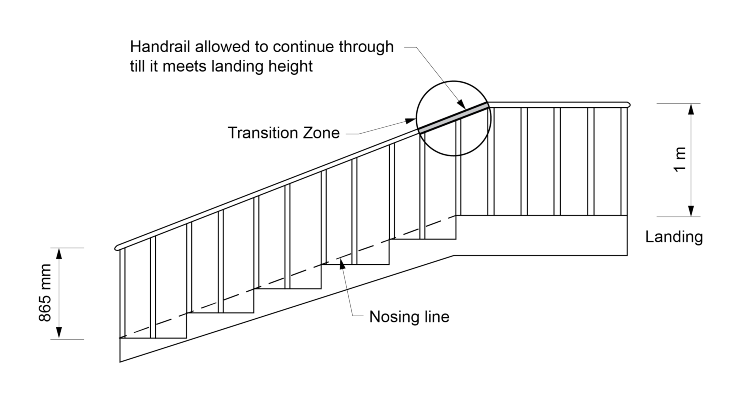
Figure D3D22b illustrates the use of handrails complying with D3D22.
Figure D3D22a: Illustration of ball-type stanchions
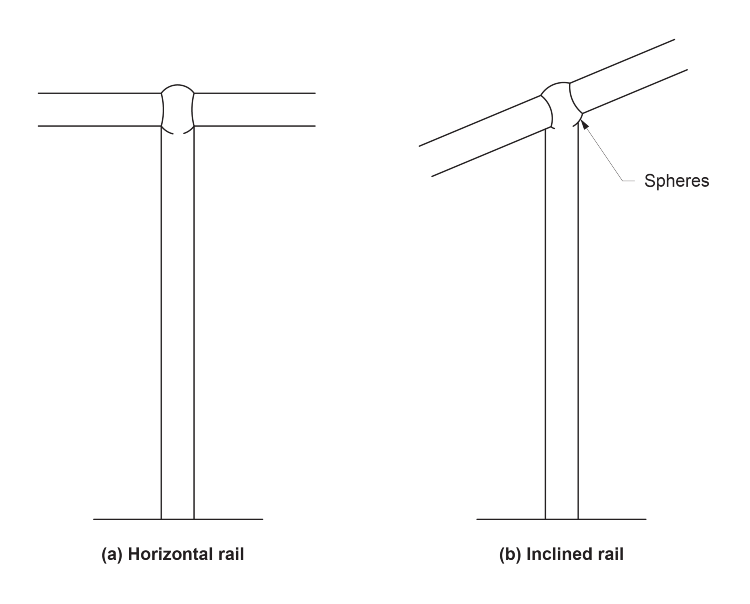
Figure D3D22b: Illustration of handrails complying with D3D22 which form part of a barrier